Building Approval Process in Himachal Pradesh

Updated: Apr 19
From Land Verification to Occupancy Certificate
Introduction
Constructing a building involves more than design and construction—it requires compliance with a number of legal and regulatory procedures. Across the world, governments establish building regulations to ensure structural safety, environmental protection, and planned development.
In India, building approvals are governed by national guidelines such as the National Building Code (NBC) along with state and local regulations. In Himachal Pradesh, the process involves coordination with multiple authorities including the Town and Country Planning Department (TCP), municipal bodies, and other government departments.
Understanding the building approval process in Himachal Pradesh can help landowners, developers, and clients avoid delays, legal complications, and costly redesigns during construction.
Overview of the Building Approval Process in Himachal Pradesh
The building permission process in Himachal Pradesh generally follows the sequence below:
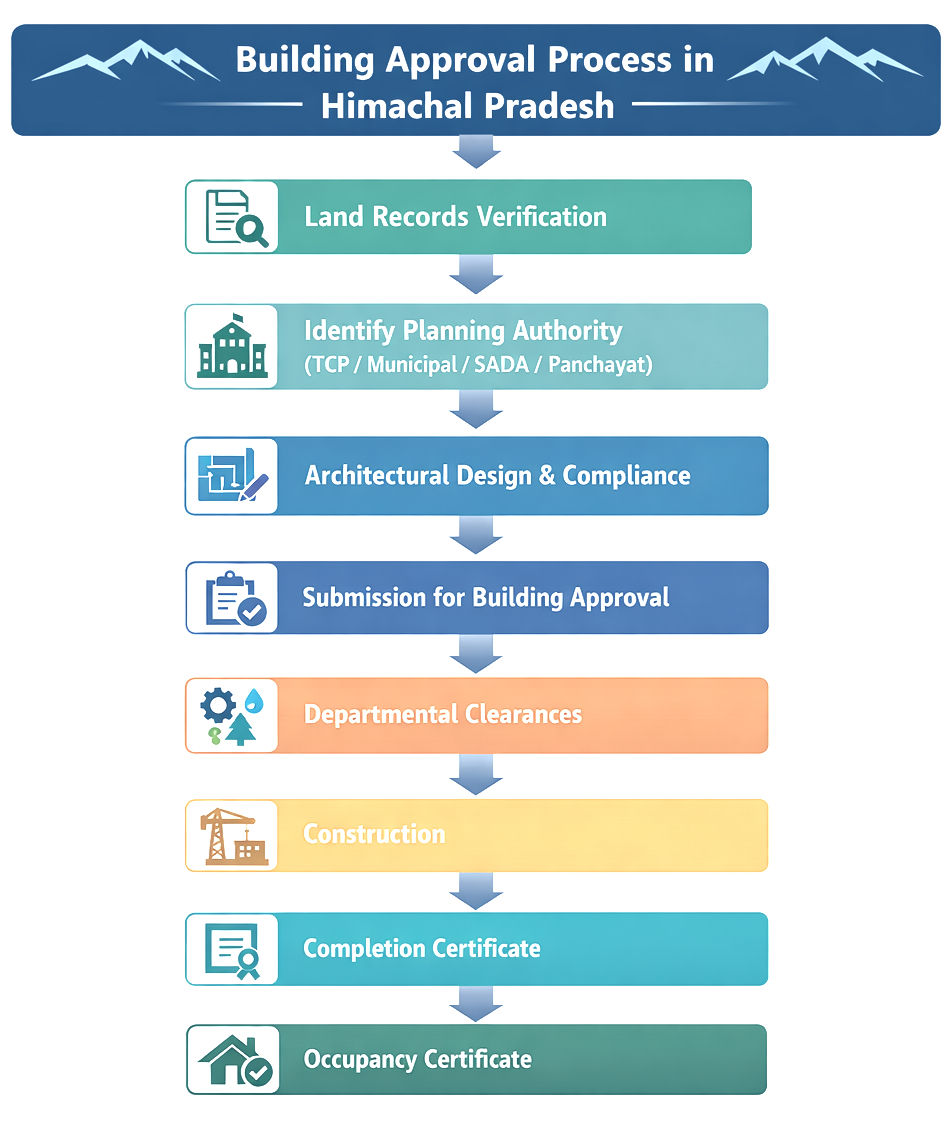
1. Land Title Verification
Before starting any building project, verifying the legal status of the land is essential. Proper land due diligence ensures that the project can proceed without ownership disputes or regulatory complications.
Important Documents
Jamabandi—Record of land ownership
Tatima / Mouka Tatima—Land parcel map
Mutation records
Land use classification
Encumbrance certificate
Authorities Involved
Revenue Department
Tehsil Office
Patwari
This step confirms ownership clarity and verifies whether the land is eligible for construction.
2. Identifying the Planning Authority
One of the important steps in the building approval process in Himachal Pradesh is identifying the correct planning authority.
Depending on the project location, approvals may be required from:
Town and Country Planning Department (TCP), Himachal Pradesh
Special Area Development Authority (SADA)
Municipal Corporation / Municipal Council / Nagar Panchayat
Gram Panchayat
Each authority regulates development through building bylaws that control:
Floor Area Ratio (FAR)
Building height
Setbacks
Ground coverage
Parking requirements, etc.
3. Preparation of Architectural Drawings
Once planning regulations are confirmed, the architect prepares the building drawings in accordance with local regulations and the National Building Code (NBC).
Drawings Typically Include
Site plan
Floor plans
Sections
Elevations
Area calculations
Parking layout
Professionals Involved
Architect
Structural Engineer
These drawings must comply with TCP regulations in Himachal Pradesh or local municipal bylaws.
4. Submission for Building Approval
The prepared architectural drawings are submitted to the relevant authority to obtain building permission in Himachal Pradesh.
Documents Typically Required
Ownership documents (Jamabandi, Tatima etc.)
Site plan
Architectural drawings
Structural safety certificate
Soil investigation report (in certain cases)
Architect’s registration details
Authorities Granting Approval
Town and Country Planning Department (TCP)
Municipal authorities
SADA authorities
After approval, the authority issues a Building Permit, which legally allows construction to begin.
5. Structural and Safety Compliance
Due to the seismic sensitivity of the Himalayan region, structural safety is a critical requirement for construction in Himachal Pradesh.
Key Requirements
Earthquake-resistant structural design
Structural stability certification
Compliance with relevant IS codes
Professionals Involved
Structural Engineer
Architect
These measures ensure that buildings are safe and durable in mountainous terrain.
6. Utility and Departmental Approvals
Several departments may be involved in providing clearances before construction or occupancy of a building.
Key Departments Involved
Himachal Pradesh State Electricity Board Limited (HPSEBL) Responsible for electricity supply and power connections.
Jal Shakti Department manages water supply and sewerage infrastructure.
Fire Department Required for hotels, commercial buildings, and larger developments to ensure fire safety compliance.
Himachal Pradesh Public Works Department (HPPWD) Permission may be required when:
The site is accessed through a PWD road
A new road access or driveway connection is needed
The building lies near a state highway
Forest Department
Clearances may be required when:
The project is located near forest land
Tree-cutting permissions are required
The site falls within eco-sensitive zones
Himachal Pradesh Pollution Control Board (HPPCB)
Applicable mainly for commercial projects, resorts, hotels, and industrial developments.
Early coordination with these departments can help streamline the construction approval process in Himachal Pradesh.
7. Completion Certificate
After construction is completed, the architect submits a Completion Certificate confirming that the building has been constructed according to the approved plans.
Documents Submitted
Completion drawings
Structural stability certificate
Photographic documentation
Compliance declaration by the architect
The authority verifies whether the building complies with the approved design.
8. Occupancy Certificate (OC)
The Occupancy Certificate in Himachal Pradesh is the final approval required before a building can be legally occupied.
What the OC Confirms
Construction matches the approved drawings
Safety requirements are satisfied
Basic services are operational
The building is safe for use
Without an Occupancy Certificate, occupying the building may not be legally permitted.
Key Stakeholders in the Building Approval Process
Successfully navigating the construction approval process in Himachal Pradesh requires coordination between several professionals and government authorities.
Professionals
Architect
Structural Engineer
Contractor
Surveyor
Geotechnical Engineer
Government Authorities
Revenue Department
Town and Country Planning Department (TCP)
Municipal Authorities
Himachal Pradesh State Electricity Board
Jal Shakti Department
Fire Department
HPPWD
Forest Department
Pollution Control Board
Common Challenges in Getting Building Permission in Himachal Pradesh
Some common challenges faced during the building approval process include:
Incomplete documentation
Delays in departmental clearances
Road access permissions from HPPWD
Forest proximity regulations
Misinterpretation of local bylaws
Engaging experienced professionals early in the project can help reduce delays and ensure smoother approvals.
Conclusion
The building approval process in Himachal Pradesh involves multiple stages, stakeholders, and regulatory checks. While the process may appear complex, these regulations play an important role in ensuring safe construction, environmental protection, and planned development.
For landowners and developers, understanding the legal process for building permission and occupancy certificate in Himachal Pradesh can significantly improve project planning and reduce risks during construction.
Important Note
This article provides a general overview of the building approval process in Himachal Pradesh and may not include every regulatory requirement or site-specific condition. Approval procedures can vary depending on location, project type, and governing authority. It is advisable to consult a qualified architect or planning professional when planning a construction project to ensure compliance with the latest regulations.


Comments